
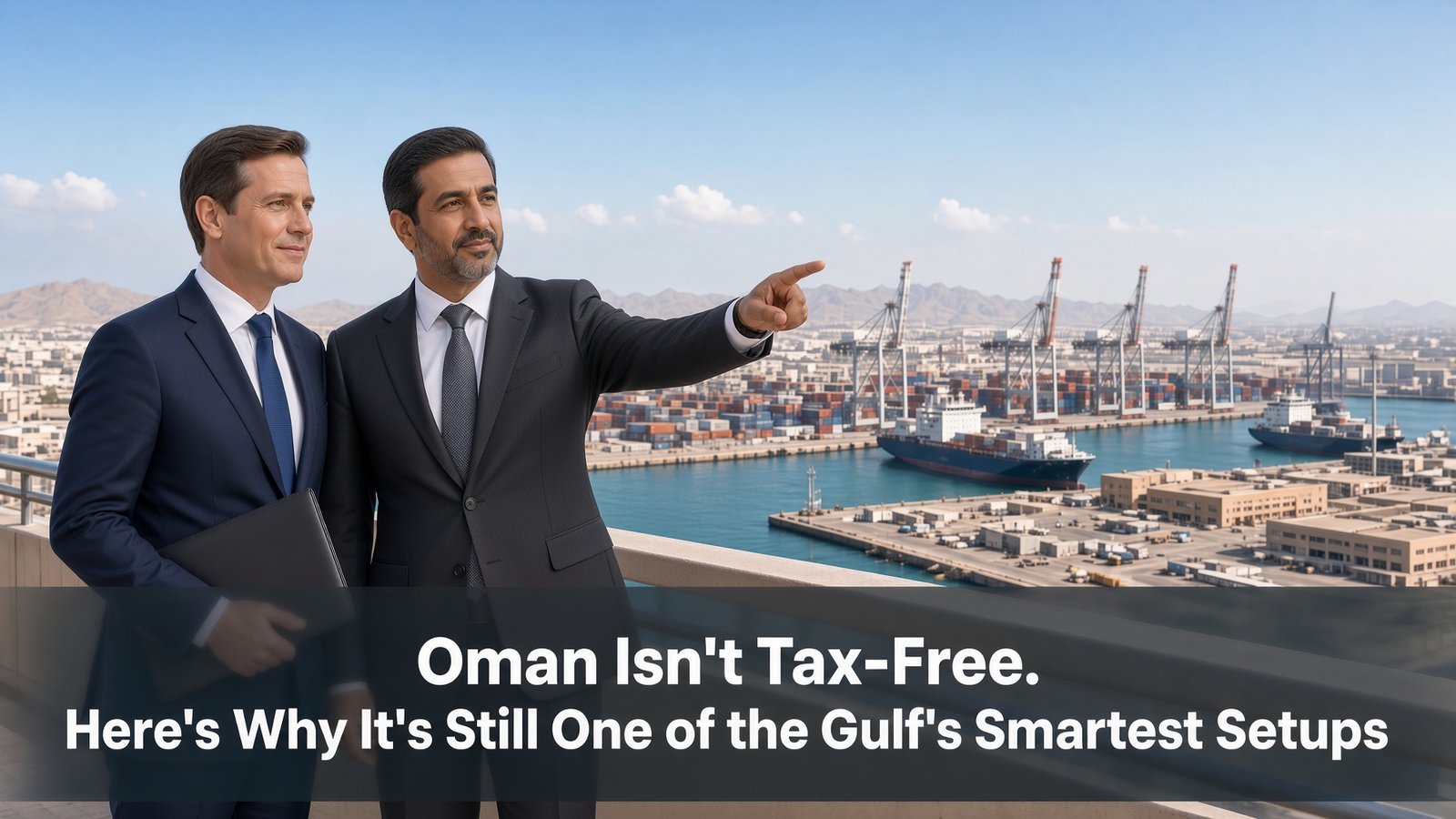
Founders comparing Gulf jurisdictions usually run the same filter. Zero tax first, everything else second. Oman fails that filter within about thirty seconds, and most people move on without looking further.
Which is a shame, because the businesses that do look tend to find something the zero tax screen never shows them.
Oman charges 15% corporate income tax. It has 5% VAT. And from January 2028 it will become the first Gulf state to apply a personal income tax, at 5% on individual income above OMR 42,000 a year. On a headline comparison it looks like the expensive option. In practice, for the right kind of business, it is frequently the cheaper one.
Table of Contents
What Oman actually charges
Corporate income tax is a flat 15% for most companies, under the Income Tax Law issued by Royal Decree 28/2009 and its later amendments. A reduced 3% rate applies to qualifying small businesses that meet conditions on registered capital, gross income and headcount, currently framed around capital not exceeding OMR 60,000, gross income not exceeding OMR 150,000 and no more than 25 employees on average, with certain sectors excluded.
VAT is 5%, with mandatory registration once annual taxable supplies pass OMR 38,500 and voluntary registration available from OMR 19,250. Exports are zero rated. Withholding tax of 10% applies to certain payments to foreign entities such as royalties, while withholding on dividends and interest has been suspended.
There is no personal income tax today. The new law, decreed in 2025, takes effect on 1 January 2028 and applies 5% only above OMR 42,000 of individual income, which leaves the overwhelming majority of residents unaffected.
Global minimum tax rules now also apply to very large multinational groups across the region, including Oman and the UAE, so the very biggest companies face a 15% effective floor regardless of local incentives.
Why the headline rate misleads
Three things change the picture once you move past the rate.
The zones do the heavy lifting. Oman’s special economic zones and free zones offer income tax exemptions running as long as 30 years, alongside 100% foreign ownership, customs relief and no minimum capital requirement in several zones. The Special Economic Zone at Duqm, Sohar Free Zone, Salalah Free Zone, Al Mazunah and Knowledge Oasis Muscat each target different sectors. Royal Decree 38/2025 unified the framework governing these zones, which tidied up an area that was previously fragmented. For a manufacturer, a logistics operator or an exporter, a long exemption inside a zone beats a low headline rate somewhere else.
Geography is a genuine commercial asset. The ports of Sohar, Salalah and Duqm sit on the Arabian Sea, outside the Strait of Hormuz, with direct access to India, East Africa and Southeast Asia. Salalah is among the largest transshipment ports in the region. For anyone moving physical goods, that routing has real value and is not something a tax rate can replicate.
Competition is lower. Oman has a fraction of the market saturation of Dubai. Commercial rents, staffing and operating costs generally run lower, and in several sectors you are not fighting three hundred competitors for the same tender. For service businesses billing regionally, the cost base often matters more than the tax line.
What foreign investors get
Under the Foreign Capital Investment Law, updated in 2020, foreign investors can own 100% of a company in most sectors, with no local partner required. The most common structure is a limited liability company registered with the Ministry of Commerce, Industry and Investment Promotion, with a single person company available for solo founders. Free zone entities, branches and representative offices round out the options.
Registration runs largely through the national digital platform, and straightforward setups can complete in a matter of days once documents are ready. Capital, profits and dividends can be repatriated without restriction.
The obligations to plan for
Oman is a real tax jurisdiction, so treat compliance as part of the operating cost, not an afterthought.
- Register with the Tax Authority after your commercial registration is issued, regardless of company size.
- Corporate tax returns are filed within four months of the financial year end, and VAT returns quarterly.
- Companies above certain capital and size thresholds must have audited financial statements, and properly prepared accounts are expected with tax filings.
- Omanisation quotas apply and increase as your business grows. Plan hiring accordingly.
- Zone incentives come with conditions, including economic substance expectations, so the exemption has to be earned and maintained.
How setting up actually works
The sequence is more predictable than the reputation suggests.
You reserve a trade name and choose your legal form, most commonly a limited liability company or a single person company for solo founders. You prepare the constitutive documents, passports and any parent company paperwork, which for foreign corporate shareholders needs authentication and legalisation through the Omani Embassy or Consulate before it is accepted. You register through the national platform run by the Ministry of Commerce, Industry and Investment Promotion, and receive your commercial registration.
From there you register with the Chamber of Commerce, register with the Tax Authority, secure premises, open a corporate bank account and begin labour and residency processing for your staff.
Free zone routes run in parallel through the relevant zone authority, and typically involve securing an office, warehouse or industrial plot on a lease, usually of at least five years, before the licence is issued. Company registration now also supports longer residency options for investors and their families, which matters if you intend to be present rather than remote.
Banking is the step that most commonly determines your timeline. A director visit and clear documentation on source of funds speeds it considerably.
Who Oman genuinely suits
Manufacturing, processing, logistics, fisheries, mining services, tourism and export focused businesses that will use a zone. Companies serving India and East Africa that want Gulf presence without Gulf overheads. Founders who value a stable, quiet operating environment over a marketing address.
Who it suits less: a pure holding structure chasing a zero rate, or a consultancy whose clients are all in Dubai.
FAQ
What is the corporate tax rate in Oman?
A flat 15% for most companies, with a reduced 3% rate for qualifying small businesses.
Is there personal income tax in Oman?
Not today. From 1 January 2028 a 5% tax applies to individual income above OMR 42,000 a year.
Can foreigners own 100% of an Omani company?
Yes, in most sectors, with no local partner required.
What do free zones offer?
Long income tax exemptions of up to 30 years, full foreign ownership, customs relief and relaxed Omanisation rates.
How long does setup take?
Straightforward registrations can complete within days once documents are prepared, with banking usually the longer step.
Weighing Oman against the alternatives?
Black Swan Business Setup Services has an office in Muscat and forms companies across mainland Oman and its free zones, alongside the UAE, Saudi Arabia and Bahrain. Compare your options at https://omanbss.com/